

How Loud is a Personal Alarm? A Guide to Volume, Benefits and Proper Use
Personal alarms are often marketed with one purpose: they are loud. But loud compared to what? And, why does loudness matter in a real-world safety situation?
Personal alarms should be a staple in your safety toolkit, offering a compact method for attracting attention when you feel as though your safety is compromised. When you feel unsafe, noise is your best friend. To understand the effectiveness of personal alarms, it helps to look beyond product claims and explore how sound works, how humans react to it, and how personal alarms fit into everyday safety scenarios.

SABRE Personal Alarm with LED Light and Snap Hook
Why are people buying personal alarms?
Personal alarm purchases are part of a broader trend of personal safety tools gaining popularity. While no one tool guarantees protection, personal alarms are part of a layered approach to stay safe. They are a simple device that can generally be carried anywhere – even places where pepper spray is not allowed, such as on airplanes, at concerts, and sporting events.
What are personal alarms?
Personal alarms are small, portable devices designed to emit a loud sound when activated. Like the SABRE 2-in-1 Personal Alarm and SABRE Personal Alarm with LED Light and Snap Hook, activation is simple with a double click on the SOS button or quick pull of a pin.
The devices feature a high-decibel siren. SABRE’s 2-in-1, for example, is a fiercely loud 130dB, compact size, and battery-powered with a long use span. Many also include extras like an LED flashlight or strobe light.
Personal alarms are used by millions of people every day, including students on campus, runners and walkers, elderly individuals, and travelers. Some parents even clip one to their child’s backpack.
So, how loud are personal alarms?
It’s one thing to read “loud siren,” and it’s another to understand what that means practically.
Let’s start with the decibel (dB) scale. It offers a standard measurement to determine the intensity of sound. An increase of 10dB represents a tenfold increase in power, making it easier to compare a wide range of sound levels.
The common decibel scale ranges from zero to 165, with outliers for rocket launches and gun shots, which can reach above 200db. For an additional perspective, conversational speech is in the 50dB to 60dB range. By comparison, a 130db personal alarm has a volume similar to a military jet at take off.
Manufacturers like SABRE aim for extremely high decibels so personal alarms can be heard even in loud environments and at a distance. The SABRE 2-in-1 Personal Alarm can be heard up to 1,800 feet away, which is particularly useful in more remote areas like alleyways or parks. The object of the sound is to startle a potential attacker, draw attention from others nearby and clearly signal distress in noisy environments.
Comparison chart: personal alarms to familiar sounds
Personal alarms are often as loud as or louder than emergency sirens and audible from hundreds of feet away. They’re designed to cut through background noise. Let’s compare.
|
Decibel (dB) |
Activity |
|
20 dB |
Leaves rustling |
|
60 dB |
Conversation |
|
80 dB |
Dog barking |
|
85 dB |
Drilling |
|
110 dB |
Concert |
|
120 dB |
|
|
130 dB |
The pain threshold sits between 110 and 120 dB. To ensure it’s effectivenes, all SABRE personal alarm products are 120dB or higher, most 130dB.
Why should I carry a personal alarm?
Personal alarms are part of a comprehensive safety plan that includes behaviors (staying in groups, being aware of surroundings) and nonlethal and less lethal safety devices. Personal alarms fall into the “non-lethal” device category.
They are often selected because they do not require physical force and they are generally allowed in places where other safety tools might not be. They also don’t require special training to use and activate, though it’s recommended to test the device ahead of time to be prepared ahead of needed use – and check it regularly to ensure the battery has not died.
The loud noise aims to scare potential threats, interrupt during a threatening situation, and call attention to others. The ultimate objective is to give the user time to get to safety. They offer peace of mind and encourage confidence during daily activities.
When should I carry and use a personal alarm?
There are dozens – hundreds – of situations where carrying a personal alarm might be useful, such as walking alone at night, jogging or hiking through a wooded area, on public transportation, in parking garages, at concerts and events, and other circumstances where an area is unfamiliar, isolated, or large groups are gathered.
Don’t hesitate to trigger the alarm the moment something feels threatening or it appears another person is following you, and trigger it immediately in the event of attempted physical contact or harassment.
How do I use a personal alarm?
Devices can vary in how to activate the alarm, but the two most common ways are via a pin or simply pressing a button.
Pin-devices require pulling out a thin insert, likely metal, and pushing it back into the device when a threat is neutralized or the user gets to safety. Those with an SOS button require a double click to activate and a single click or a few second hold to deactivate. Once activated, hold the alarm as far away from your own ears as possible.

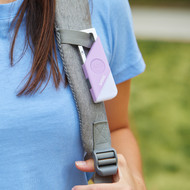
Carry your personal alarm by attaching it to a keyring, bag strap or belt loop. Keep it easily reachable and not buried inside a bag. As you activate the device or as soon as it renders a threat immobile, immediately move toward a well-lit, populated area, if possible. Continue sounding the alarm until help arrives or there is no longer a risk.
What are the limits of a personal device?
Personal alarms are suggested as part of a thoughtful safety plan; however, there are situations where loudness alone cannot guarantee safety, and in some extremely noisy environments, it might be less effective. If the threat or attacker is not deterred by a personal alarm, you will need to take other countermeasures, such as pepper spray, which provides users with the ability to defend and protect themselves.
Personal alarms are widely accessible and loud by design, operating at volumes comparable to emergency sirens to ensure they are impossible to ignore. That intensity of sound helps interrupt threatening situations, draw immediate attention, and clearly signal distress when words or movement may not be enough. While no single tool can guarantee safety, personal alarms play an important role in a layered safety approach thanks to their ease of use, wide legality, and nonlethal nature. When carried accessibly and used without hesitation, they can create crucial moments to escape a situation or get help.
That said, if no one is around or you’re going on a run or a walk on a secluded trail, no one is going to hear your personal alarm. That’s why it’s important to carry other self-defense tools in addition to your personal alarm. We recommend pepper spray or pepper gel that provides you with a way to defend yourself from 10 to 14 feet away.