


Bear Attack Safety: What To Do in a Black Bear Encounter
Black bears are the most common bear species in North America by population and geographic range. An estimated 750,000 to 900,000 black bears are distributed across Canada and the United States, with the highest densities in western Canada, the Appalachian Mountains from Maine to northern Georgia, the northern Midwest, the Rocky Mountain region, the West Coast and Alaska. In recent decades, sightings have expanded into states including Ohio, Illinois, Indiana and western Nebraska. As their range grows and human outdoor recreation increases, encounters are becoming more common. Understanding how to respond — and how to prevent an encounter from escalating — is a matter of preparation, not panic.
Black Bears vs. Other North American Bear Species
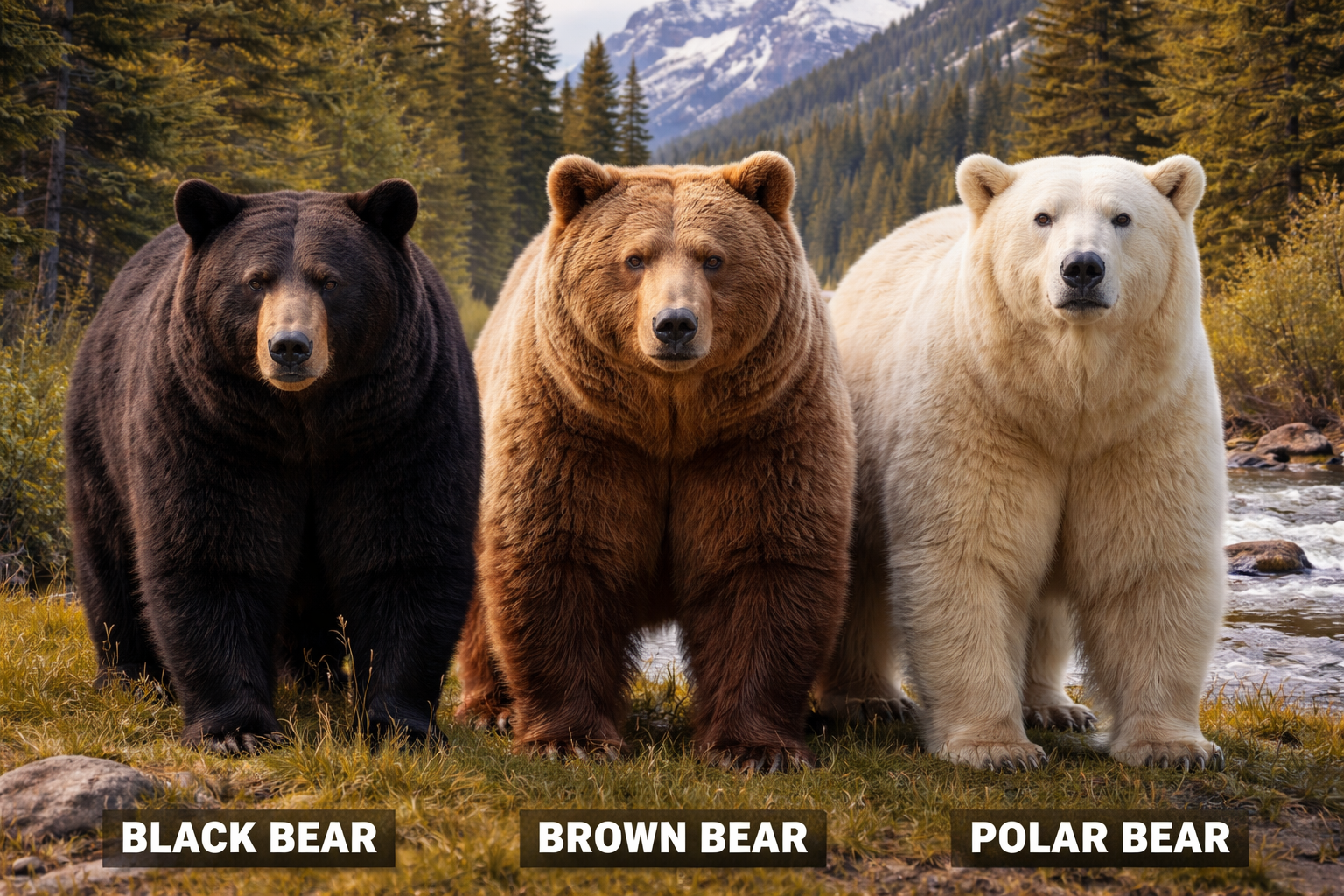
North America is home to three bear species: the American black bear, the brown bear (including the grizzly subspecies) and the polar bear. Of the three, black bears are the smallest and least aggressive toward humans. Brown bears, found primarily in Alaska, western Canada and isolated pockets of the northern Rockies, are significantly larger and more likely to respond defensively to a perceived threat, particularly when a female bear is protecting her cubs. Polar bears, limited to Arctic regions, are the largest of the three and considered the most predatory toward humans, though encounters outside of remote northern communities are exceedingly rare.
Visually, black bears are frequently misidentified. Despite the name, their coats range in color from jet black to cinnamon, blonde and even white in some regions, overlapping with brown bear coloration. The most reliable distinguishing features are physical: black bears have a straight facial profile, no prominent shoulder hump, and shorter, more curved claws suited for climbing trees rather than digging. Brown bears have a pronounced shoulder hump, a dished facial profile and longer, straighter front claws.
Understanding Black Bear Behavior
Most black bear encounters fall into one of two categories: Defensive and predatory encounters: Defensive encounters occur when a bear is surprised, feels cornered or perceives a threat to its cubs. These are far more common, and the bear's goal is to neutralize the perceived threat — not to prey on the person. Defensive reactions are typically brief. Predatory encounters, on the other hand, are rare and involve a bear that has identified a human as a potential food source.
The most common outcome of a black bear encounter is the bear leaves. Black bears are generally afraid they will be attacked and in the vast majority of encounters, they run when detecting a human. Most people who report seeing a black bear describe the animal moving away before any interaction develops. When a bear does not immediately retreat, its behavior generally falls into one of several recognizable patterns:
- Standing on hind legs. This is widely misread as aggression. A bear that is standing on its hind legs is usually trying to get a better view — it is not a threat display and does not signal that the bear is about to charge. According to recent research, black bears' long-distance eyesight is not very good. They can likely only see forms from 100 yards away and are not able to see details of large objects from further than 30 yards away. Bears rarely attack, but when they do, it is on all fours with their heads down.
- Stress displays. A bear that feels threatened does not roar or growl. Instead, it may slap the ground, huff or blow air forcefully through its nose or mouth, and snap or pop its teeth together. These are warning communications — the bear is signaling discomfort and asking for more space, not preparing to attack.
- Bluff charges. Bears will often bluff charge to scare a person away, veering off or stopping short at the last second. Bluff charges typically occur with a hopping or bouncing motion, with the bear's head up and legs stiff. These are unnerving but are distinct from an aggressive charge, in which the bear's head is down and ears are back.
- True aggression. A bear that is truly aggressive toward humans does not make a sound. Instead, it stares, protrudes its lower lip and flattens its ears. When a bear charges in earnest, it comes low and fast on all fours
Prevention: The Most Effective Safety Strategy
The most reliable way to survive a bear encounter is to avoid one entirely. The following measures significantly reduce encounter risk:
- Make noise on the trail. Bears that hear humans approaching generally move away before any visual contact occurs. Talking, clapping or using a bear bell on your pack provides a continuous auditory warning to bears along the trail. A bear bell is a small, passive noise-making device that clips to a pack or clothing and produces a consistent ringing sound with each movement.
- Use a bear horn. While a bear bell provides continuous low-level noise to signal your presence, a bear horn delivers a powerful blast to drive away nearby bears before an encounter occurs. Use a bear horn when you detect signs of bear activity — sound, odor or movement — or as an intermittent alert when traveling through dense, high-risk terrain. Bear horns are a preventive tool. They are not designed to stop a bear that has already identified you or is actively charging.
- Travel in groups. Most documented black bear attacks have involved lone individuals or pairs. Larger groups are louder, take up more space and are less likely to be approached.
- Be alert in high-risk environments. Dawn, dusk, and areas near water sources, berry patches, or animal carcasses carry elevated encounter risk. Reduce trail speed and increase noise output in these conditions.
- Secure food and scented items. Bears that associate humans with food are more likely to approach campsites and more likely to behave aggressively when their access to that food is interrupted. Store food in bear-resistant containers or hang it properly. This applies to garbage, cooking equipment and toiletries.
Carrying Bear Spray: What the Data Shows
Bear spray — a capsaicin-based aerosol deterrent — is consistently identified in the scientific literature as the most effective close-range deterrent available to people in bear country.
Read more: Bear Spray 101: What It Is, How It Works, and Why You Need It
A 2008 study published in the Journal of Wildlife Management analyzed 83 bear spray incidents in Alaska from 1985 to 2006. The findings were significant: bear spray stopped black bears' undesirable behavior in 90% of cases, and 98% of all persons carrying spray during close-range encounters escaped uninjured. For comparison, a separate analysis of 269 bear-human conflicts involving firearms found that firearm bearers suffered similar injury rates whether they used their firearm or not.
Bear spray is a non-lethal deterrent. When deployed correctly, it produces a dense cloud of capsaicin that causes temporary but intense irritation to a bear's eyes, nose and respiratory system, which is sufficient in most cases to redirect or stop a charge without permanent harm to the animal.
Key deployment guidelines
Bear spray must be accessible, as in a holstered hip holster or chest strap, not stored inside a pack. A can buried in a bag is of no use during a charge, which can close the distance between bear and person in seconds.
When a bear is approaching aggressively, remove the safety clip, grip the canister and aim (about 60-80 degrees) downward toward the advancing bear. The goal is to create a cloud the bear runs into rather than spray directly at its face from close range, which may be too late. Be aware of wind direction; a headwind can reduce spray range or redirect the cloud.
Bear spray is not a repellent. Do not pre-spray clothing, tents or equipment.
Check the expiration date before each season. Do not store spray canisters in vehicles where interior temperatures can exceed 120 degrees Fahrenheit, as pressure buildup may cause canister failure.
Select the right bear spray
Not all bear spray pack the same punch. SABRE Frontiersman MAX bear and mountain lion spray is industry-leading. This brand’s bear spray is formulated with 2.0% major capsaicinoids, the strongest formula approved by the EPA. Pair that heat with a wide spray pattern and long reach, and it creates one of the most effective self-defense tools on the market.
Using a Bear Horn: Deterrence at a Distance
A bear horn is an audible deterrent that emits a loud, sharp blast intended to startle a bear and encourage it to leave the area. It is most useful before a bear has been sighted, providing you with a safe journey along your walk, hike or outdoor adventure.
Bear horns are compact, operate without batteries (most are compressed-air canister models), and function in adverse weather conditions. They are appropriate for use in campsite defense, when a bear is moving toward a group, or when attempting to drive a food-conditioned bear away from a camp area.
However, a bear horn is not a substitute for bear spray in a close-range encounter. At distances under 30 feet with a charging bear, the spray's ability to create a physical deterrent is more reliable than sound alone.
What to Do During an Encounter
- If you see a bear at a distance: Do not approach. Give the bear space and a clear exit route. Speak calmly to identify yourself as human. Back away slowly without turning your back. If the bear moves away, continue out of the area at a measured pace.
- If a bear charges: Most charges by black bears are bluff charges: the bear stops short, makes noise and retreats. Hold your position, avoid running (which can trigger a predatory response), and prepare your bear spray.
- If the charge is not a bluff and contact is imminent: Deploy bear spray at the approaching bear. If contact occurs, fight back. This guidance is specific to black bears and differs from brown or grizzly bear protocol, which suggests playing dead. In the event of black bear contact, target the bear's face and nose and use any available object — trekking poles, rocks or personal items — as improvised defensive tools.
If the attack appears defensive (e.g., the bear was surprised and swiped or bit once before retreating), assess injuries and leave the area. Report the encounter to local wildlife management authorities.
After a Bear Attack/Encounter
Report any encounter involving physical contact, close approach, or a bear that appeared food-conditioned to your local or state wildlife agency. Reporting is important because it enables wildlife managers to identify problem animals, assess behavior patterns, and intervene before more serious incidents occur.
If the encounter involved a campsite intrusion or food access, assess and correct any practices that may have attracted the bear. Food-conditioned bears are more likely to approach people and are more difficult to deter.
Assembling a Bear Safety Kit
Practical preparation for travel in black bear habitat includes:
- Bear spray carried in an accessible holster
- Bear horn for deterrence at range and campsite defense
- Bear bell attached to pack or clothing for passive trail noise
Know how to correctly deploy each item before entering bear country. No single item replaces situational awareness, but each tool addresses a distinct phase of encounter risk: the bell reduces the likelihood of a surprise encounter, the horn provides deterrence at distance, and bear spray addresses close-range defensive situations.
The Bottom Line
The data consistently support early noise-making to avoid encounters, bear spray as the primary close-range deterrent, and — in the event of contact — an active rather than passive defensive response.
Preparation before entering bear habitat is the most reliable safety measure available. Carrying the right tools, knowing how to use them, and understanding bear behavior provides a functional and evidence-based framework for managing encounters when they occur.