

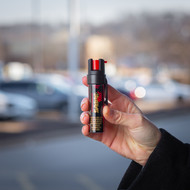
SABRE vs. Mace®: Which Pepper Spray Is Best For You
In 2026, SABRE's team compiled independent laboratory performance data, product specifications, and law enforcement adoption records to compare Mace® Brand and SABRE Red pepper spray across five factors to help users identify which personal defense spray is best for their situation.
Before diving in, one important note: many consumers use "mace" as a generic term for any pepper spray. This is because of the original Mace CN-based tear gas product first introduced in 1965. This article focuses specifically on Mace® Brand, the modern oleoresin capsicum (OC)-based personal safety company.
Both brands in this comparison sell OC-based sprays for everyday carry. Both are available nationwide. Where they differ is in how each brand verifies what is inside every canister, how far and how long each spray performs, and whether the brand behind the product is used by police forces around the country.
Here is what this guide covers:
- How each brand verifies the potency of its formula
- Spray duration and what independent performance data shows
- Spray range and how each canister performs at distance
- Carry formats and the product lineup available from each brand
- Law enforcement adoption and which brand agencies actually choose
SABRE vs. Mace®: At a Glance
In the table below, we break down SABRE Red vs. Mace® Brand pepper spray across eight key performance factors.
Mace® Brand vs. SABRE Pepper Spray [1,2]
|
Factor |
Mace® Brand |
SABRE Pepper Spray |
|
Active Ingredient |
Oleoresin capsicum (OC) Some products also contain CS tear gas |
Oleoresin capsicum (OC) Some products also contain CS Tear GAS and UV Marking Dye |
|
Major Capsaicinoids (MC%) |
Not documented publicly for standard keychain SKU |
1.33% |
|
Formula Verification |
Not publicly documented |
Every production batch is tested via an in-house HPLC lab |
|
Spray Duration (entry carry SKU) |
Not publicly documented |
10 seconds (SABRE personal sprays) |
|
Spray Range |
Up to 12 feet (personal sprays) |
12 to 14 feet (SABRE personal sprays) Up to 16 feet (select pepper gels) Up to 20 feet (select MK3 pepper gels) |
|
Carry Formats |
Key ring, quick release, sports band |
Key ring; key chain case; quick release key ring; snap clip, belt or attachment clip; hand strap; and home defense wall mount |
|
Law Enforcement Adoption |
None documented, but Mace® sells a law-enforcement grade product |
NYPD, Chicago PD, U.S. Marshals, and thousands of other police forces in the U.S. and globally |
|
Price (entry carry SKU) |
$9.99+ |
$9.99+ |
What's in the Formula? How Each Brand Verifies Potency
When looking at the strength of pepper spray, you will see two percentages: Major Capsaicinoids (MC) and oleoresin capsicum (OC)
- MC% is the metric that actually determines pepper spray effectiveness. This is the concentration of the active compounds that cause an involuntary inflammatory response on contact.
- OC% measures the capsaicinoids (an oil extracted from capsicum peppers). These are the compounds responsible for the heat and inflammatory response associated with pepper spray. It only measures the volume of raw pepper extract, not how potent that extract is in the finished formula.
SABRE's formula is verified at 1.33% MC through an in-house HPLC lab. Mace® Brand's standard keychain and hard-case sprays do not publicly document the MC% although they list a 10% OC. These two measures are not comparable because one measures the potency of the formula and the other measures volume of the raw pepper extract. [1,2]
To put 1.33% MC in context: civilian and law enforcement pepper sprays typically range from 0.67% to 1.33% MC. SABRE's 1.33%
According to an independent study from the University of Utah, there are variability rates of active ingredients in commercially available pepper spray, including products from the same manufacturer. The researchers concluded that this variability could alter pepper spray potency and potentially jeopardize user safety.[3] SABRE addresses formula consistency with its industry-exclusive HPLC laboratory. With this in-house testing for every batch, the company is guaranteeing maximum strength heat consistency in every batch to increase user safety.
SABRE is also the only pepper spray brand with an in-house HPLC laboratory. Every production batch is tested before it ships. Mace® Brand does not publicly document whether its products undergo batch-level HPLC testing, or whether any testing is conducted in-house versus by a third party.
Spray Duration: What the Performance Data Shows
Spray duration determines how many options you have in a real situation, so it is a critical measure when comparing pepper spray products. More time means more opportunity to maintain distance, confirm contact, and deploy again if the first burst does not connect. More time means an opportunity to protect yourself in multiple attacker scenarios.
SABRE personal sprays deliver 10 seconds of spray time. Based on an independent third-party test of SABRE vs. top competitors (Mace Brand® Pocket Model, Guard Dog™ Laser PS-GDAF-BK, Guard Dog™ Pepper Slime PSL-GDQA-BC and Bling Sting™ BS2 BLKG), SABRE outperformed the spray time of all competitors, specifically beating Mace Brand® by 1.1 seconds.[4]
Mace® Brand does not publish spray duration data (in either seconds or bursts) on the standard product pages for its keychain sprays. Without third-party or brand-published performance data, spray duration cannot be compared on equal terms.
If you want spray-time performance verified by an independent test, SABRE is the best fit.
Spray Range: How Far Each Brand Reaches
Range allows the user to protect themselves from a distance. A longer range can help users maintain greater distance, while a focused stream pattern may reduce wind blowback compared with broader spray patterns.
Mace® Brand's standard keychain and hard-case sprays reach up to 12 feet using a stream delivery pattern.[2] SABRE personal sprays reach 12 to 14 feet with a stream pattern as well.[1]
For standard everyday carry, the two brands are comparable on range, although SABRE holds a slight edge by reaching up to 14 feet.
Carry Formats and Product Lineup
The right carry format depends on your specific daily context. A morning runner, an office commuter, and a college student do not carry in the same situation, and the best personal safety spray is the one you actually have with you.
Mace® Brand offers a solid core lineup across its categories: keychain sprays, clip-on hard cases, gels, personal alarms, pepper guns, and stun devices. The keychain and hard-case personal pepper spray models attach to keys, bags, or lanyards for quick access. [2]
SABRE's product line is built for a wider range of real-world carry situations. For example, the key case with quick-release keyring attaches to a daily key set, bag or purse for immediate one-hand access, while the run clip secures to an armband or waistband for hands-free carry during a morning run. The Lipstick Pepper Spray provides compact, discreet carry for anyone who wants protection that does not look like a weapon, and the 2-in-1 Pepper Spray with Personal Alarm combines two layers of deterrence in one canister. [1]
SABRE also organizes its lineup by lifestyle: Commuter Safety, Home Security, Travel Safety, Campus Safety, Runner Safety, and Hiking Essentials. Buyers can navigate by how they live, not just by product category.
That product depth is where SABRE's lineup creates a gap Mace® Brand cannot close.
Agency Adoption: Which Pepper Spray Brand Do Police Trust?
Law enforcement agencies do not choose a carry spray on design or price. They evaluate on verified potency, batch-level consistency, and real-world performance under stress. A spray that underperforms in the field has consequences that go beyond a bad review.
It is worth addressing the history directly: the original Mace® product, introduced in 1965, was a CN-based tear gas rather than an OC capsaicin formula. CN mace was largely phased out by law enforcement.[5] Modern Mace® Brand products are OC-based and are a different product entirely. Some Mace® Triple Action products still contain tear gas alongside OC.[2]
SABRE is the #1 brand used by law enforcement in the United States. Specifically, the New York Police Department, the Chicago Police Department, and the U.S. Marshals Service have adopted SABRE products. Each agency reviewed the available options and chose SABRE. That track record is built on SABRE's in-house HPLC lab, its independent spray-time testing, and more than 50 years of consistent production.[1]
Mace® Brand does not document law enforcement agency adoption for its OC-based products on its website or in product marketing.
SABRE vs. Mace®: Which Pepper Spray Is Best for You?
Both brands use OC as the active ingredient. Both are legal for civilian carry in all 50 states, with state-level restrictions on buyer age, canister size, and OC concentration. Review the laws in your state before purchasing. SABRE's website includes a state-by-state legal reference guide.
Choose Mace® Brand if:
- You want an entry-level keychain spray at a $9.99 price point
- You want a product from a brand that has been in personal safety since 1965
Choose SABRE if:
- You want formula potency verified in an in-house HPLC lab on every production batch
- You want spray-time performance backed by an independent third-party test against top competitors
- You want a carry format engineered for your specific lifestyle (e.g. running, commuting, campus life, travel, or home defense)
- You want the brand trusted by the NYPD, the Chicago Police Department, and the U.S. Marshals Service
Frequently Asked Questions
Is SABRE Red vs. Mace®, which is stronger?
SABRE is verified at 1.33% MC through an in-house HPLC lab. Mace® Brand does not list an MC% for every product, but the standard everyday carry product has a 10% OC, which is a measure of the volume of the raw pepper extract rather than the potency that the MC% is associated with.
Is "mace" the same as pepper spray?
The two terms are often used interchangeably, but they refer to different things. The original Mace® product, introduced in 1965, was a CN-based tear gas. CN formulas were largely phased out by law enforcement. Today, Mace® Brand sells OC-based products, which function the same as other OC pepper sprays on the market. Many consumers now use "mace" as a generic term for any personal defense spray.
How far does SABRE spray compared to Mace®?
For everyday carry, SABRE has a slight advantage. Mace® Brand's standard keychain and hard-case sprays reach up to 12 feet using a stream pattern. SABRE reaches up to 14 feet. [1,2]
Which is the best mace for self defense?
If you are searching for the best mace spray for self defense and using "mace" as a generic term for pepper spray, the key factors to evaluate are verified potency, batch-level quality testing, carry format, and proven law enforcement adoption. SABRE meets all four criteria: 1.33% MC verified by an in-house HPLC lab on every production batch, spray-time performance independently tested, lifestyle-specific carry formats for any situation, and documented adoption by NYPD, Chicago PD, and the U.S. Marshals.
Conclusion
Mace® Brand and SABRE both deliver OC spray in portable formats at competitive price points. For a buyer whose priority is a simple entry-level keychain at $9.99, Mace® Brand is a functional option. For a buyer who wants formula potency verified in an in-house HPLC lab on every production batch, spray-time performance backed by independent third-party testing, carry formats built for how they actually live, and a brand that the NYPD, Chicago PD, and the U.S. Marshals chose, the answer is SABRE.
[Shop SABRE Pepper Spray at sabrered.com]
Last updated: October 12, 2026
Sources:
- Security Equipment Corporation. (n.d.). Pepper spray. SABRE. https://www.sabrered.com
- Mace® Brand. (n.d.). Pepper spray and gels. https://www.mace.com/collections/pepper-spray
- Reilly, C. A., Crouch, D. J., & Yost, G. S. (2001). Quantitative analysis of capsaicinoids in fresh peppers, oleoresin capsicum and pepper spray products. Journal of Forensic Sciences, 46(3), 502–509. https://doi.org/10.1520/JFS14999J
- Eurofins EAG Laboratories. (2023, September 25). Aerosol pepper spray testing: Security Equipment Corporation (Test Report, Rev. 2) [Unpublished test report on file prepared for Security Equipment Corporation].
- Bowling, Robert. "History of Mace/Pepper Spray." OFFICER Magazine, January 30, 2023.https://www.officer.com/tactical/less-lethal/irritant-sprays/article/21293986/history-of-mace-pepper-spray