


7.9 oz. Bear Spray & Mountain Lion Spray
- Product Accessories
- Glow in the Dark Safety Wedge
- Formula
- FRONTIERSMAN MAX
- Total Spray Time (seconds)
- 6-7
- Spray Distance (ft)
- 40
- Safety Type
- Trigger
- Spray Pattern
- Powerful Fog
FREE Shipping on Orders $50+. Shop Now.
Outdoor Safety
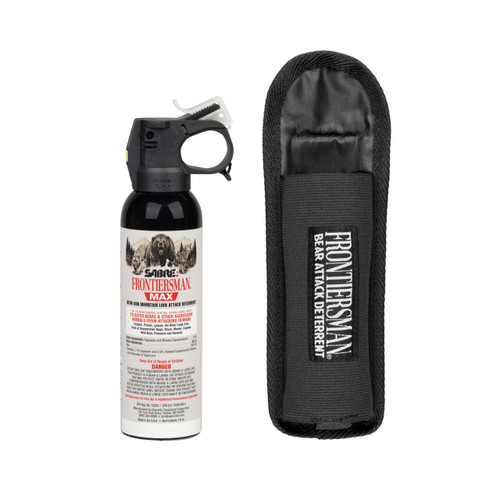
Frontiersman MAX is engineered to the highest performance standard the EPA allows: 2.0% major capsaicinoids, up to 40 feet of range, and 1.58 oz per second for fast, effective coverage in a bear encounter.

No additional filters are available.





Why Frontiersman MAX
Every canister is verified through in-house HPLC laboratory testing to ensure these specifications are met, not just claimed. Field tested at Elmendorf Air Force Base in Alaska and featured in leading outdoor safety publications, Frontiersman MAX reflects SABRE's 50+ years of family-owned manufacturing expertise. EPA-registered. ISO 9001:2015 certified.
Bear spray stops aggressive bears over 90% of the time. Firearm users are injured in roughly half of encounters.
Read the comparison →A wide capsaicin fog overwhelms a bear's eyes, nose, and lungs so it retreats instead of charging.
Learn how it works →Read the encounter, not just the species. Know when to stand your ground and when to be assertive.
Know the difference →Canadian-registered canisters can only be purchased inside Canada. Here's where to find them.
Find a Canadian retailer →Answers to the most common questions about bear spray, effectiveness, travel, and proper use.
Bear spray is a non-lethal deterrent made from oleoresin capsicum (OC), a natural compound derived from hot peppers. When deployed, it releases a heavy fog that causes intense irritation to a bear's eyes, nose, and throat — triggering disorientation and causing the animal to retreat. It is EPA-regulated, non-lethal, and considered by wildlife experts to be the most effective tool for preventing injury in a bear encounter.
Yes - and the data is clear. Bear experts and wildlife researchers agree that bear spray is significantly more effective than firearms in a human-bear confrontation. Based on four different studies, bear spray is effective in over 90% of documented encounters, while humans are injured in roughly 50% of confrontations where a firearm is used. Bear spray requires less accuracy than a gun, covers a wider area with a fog pattern, and can be deployed faster in a surprise encounter.
When deployed, bear spray releases a concentrated fog of capsaicin that causes swelling of a bear's mucous membranes, intense irritation to the eyes and nose, shortness of breath, and disorientation. The reaction is immediate and overwhelming, and causes the bear to flee rather than continue the attack. The fog pattern is key — unlike a stream, it creates a wide barrier the bear runs into, which means you don't need precise aim in a high-stress encounter.
No — and this is one of the most common misconceptions about bear spray. Research shows the opposite. A widely cited study published in the Journal of Wildlife Management (Smith et al., 2008) found that bear spray stopped aggressive bear behavior in over 90% of encounters, with bears typically retreating after exposure. Bear Spray Effectiveness When deployed properly, bear spray overwhelms the bear’s eyes, nose, and respiratory system, causing intense irritation and disorientation. This sensory disruption interferes with the bear’s ability to continue its approach, triggering it to disengage and seek relief rather than become more aggressive. How Bear Spray Works
Bear spray is the recommended choice for wildlife professionals, park rangers, and the U.S. Fish & Wildlife Service — and the data backs it up. A study published in the Journal of Wildlife Management found bear spray successfully deters aggressive bears more than 90% of the time. By contrast, U.S. Fish & Wildlife Service data shows that people defending themselves with firearms are injured in roughly 50% of bear encounters. The reasons are practical: a charging bear moves faster than most people can aim and fire accurately under stress, and a wounded bear is more dangerous than an undeterred one. Bear spray doesn't require precision — its wide fog pattern creates a barrier the bear runs into. For the full comparison, read our Bear Spray vs. Gun breakdown.
Yes. Frontiersman MAX is effective on all bear species — grizzly, brown, black, and polar bears — as well as mountain lions. The important distinction isn't which product to use, it's how to read the encounter. Grizzly bears involved in a surprise defensive encounter will typically stop an attack if you stand your ground and deploy spray. Black bears are more likely to be predatory in their approach and may require a more assertive response. In both cases, bear spray is the recommended first line of defense. Deploy when the bear is within approximately 20-40 feet and continue spraying until it diverts. For a full breakdown of behavioral differences, see our Grizzly vs. Black Bear guide.
Yes, if you're hiking, camping, or spending time in bear country. Bear attacks happen without warning and escalate in seconds. Bear spray gives you an effective, non-lethal option that works at a safe distance — before a bear reaches you. National parks including Yellowstone and Glacier strongly recommend carrying it, and many outfitters and guides require it. The question isn't whether to carry bear spray; it's which one to carry.
Bear spray and pepper spray both use oleoresin capsicum as the active ingredient, but they are not interchangeable. Bear spray contains a higher concentration of capsaicinoids — up to 2.0% major capsaicinoids (MC), the EPA maximum — and is designed to reach distances up to 40 feet. Pepper spray formulated for personal self-defense typically reaches only 8–14 feet and contains lower concentrations of the active ingredient. Using personal pepper spray against a charging bear is not recommended and will not provide adequate protection.
Both sizes contain the same EPA maximum strength formula and the same 40-foot range. The 9.2 oz canister provides more spray time — useful in multi-bear encounters. The 7.9 oz is lighter and easier to carry on day hikes. If you're in a remote backcountry area or guiding others, the 9.2 oz is the stronger choice. For most day hikers and campers, 7.9 oz is sufficient.
Remove the safety clip with your thumb and hold the canister firmly with both hands. Begin spraying when a charging bear is within approximately 20-40 feet, directing the spray in a downward arc toward the front of the bear so it runs into the cloud. Continue spraying until the bear diverts. If wind is blowing toward you, wait until the bear is closer before deploying. Practice accessing your canister from its holster before you go - in a real encounter, you will not have time to fumble with it.
Frontiersman MAX deploys up to 40 feet - the longest range available in its class. That distance is critical because it gives you a meaningful buffer before a charging bear reaches you. At 20-40 feet, begin spraying downward toward the front of the bear so it runs into the cloud. The wide fog pattern means you don't need precise aim under stress, unlike a firearm. Range is only meaningful if the formula is at full strength - which is why every canister of Frontiersman MAX is HPLC-tested to confirm it performs exactly as labeled.
No. Bear spray is not permitted on commercial aircraft in either carry-on or checked luggage. If you're flying to a trailhead, plan to purchase bear spray at your destination or ship it ahead. Many outfitters and outdoor retailers in bear country carry it. Do not attempt to fly with it — TSA and airline regulations prohibit it as a pressurized hazardous material.
Yes. Bear spray is permitted and strongly recommended in most U.S. national parks. Yellowstone, Glacier, and Grand Teton national parks specifically recommend carrying it. Some parks have loaner or rental programs at visitor centers. Check the specific regulations for the park you're visiting, as rules on storage and accessibility while hiking may vary.
Store bear spray at room temperature, away from direct sunlight and heat sources. Never leave it in a parked car — pressure canisters can leak or burst when exposed to high temperatures. When not in use on the trail, store it in a cool, dry place. Keep it accessible at your campsite, not buried in your pack.
Yes, but performance can be reduced in very cold temperatures. Extremely cold conditions can lower the internal pressure of the canister, shortening the spray range and duration. If you're hiking in cold weather, keep the canister close to your body — in an accessible chest holster or hip holster — to maintain its temperature. Do not store it outside overnight in freezing conditions.
Yes, but Canadian regulations differ from U.S. regulations — bear spray sold in Canada must meet specific Canadian Pest Control Products Act requirements. SABRE offers bear spray products specifically registered for use in Canada. If you're hiking in Canadian national parks such as Banff or Jasper, verify that your canister meets Canadian requirements before you travel. Bear Spray approved for Canada can only be purchased inside of Canada. Where to Buy Bear Spray in Canada
Yes. Frontiersman MAX has a shelf life of 3 years from the date of manufacture. Over time, the pressure inside the canister decreases, which can result in reduced range or failure to deploy. Check the expiration date printed on your canister before each season and replace it when expired. An expired canister in a real encounter is not a risk worth taking.
From the blog
Learn when and how to use bear spray, what to expect in a bear encounter, and practical tips to stay safe in the outdoors.