

Are Non-Lethal Weapons Effective? A Product-by-Product Breakdown
Personal safety decisions carry real consequences. When evaluating self-defense tools, effectiveness is the most important consideration. Non-lethal and less lethal devices have expanded significantly in capability and availability, but questions about their reliability remain common. The answer depends largely on the tool, the situation, and how well the user understands both.
Non-Lethal vs. Less Lethal
“Non-lethal” and “less lethal” are not interchangeable terms, as outlined in A Practical Guide to Nonlethal and Less Lethal Self-Defense. Non-lethal refers to tools and methods designed to incapacitate or deter without causing harm or death, such as personal alarms and situational awareness. Less lethal is a more precise designation that reflects the context and circumstances where a device like pepper spray or a pepper spray projectile launcher could have long-term effects under certain conditions.
Related to lethal weapons, the core distinction is one of design intent: less lethal tools are built to deter threats and allow a person to reach safety; lethal weapons are built to permanently incapacitate.
Effectiveness by Product Type
This article is focused on the effectiveness of less-lethal devices, like pepper sprays.
Pepper Spray and Pepper Gel
Pepper spray and pepper gel are among the most extensively tested and widely deployed less lethal tools available to civilians. Both use oleoresin capsicum (OC) as the primary active ingredient — a compound derived from hot peppers that causes immediate inflammation of the eyes, skin and respiratory tract, producing temporary incapacitation.
The distinction between spray and gel formats matters for effectiveness in specific scenarios. Traditional pepper spray disperses in a stream pattern and acts quickly upon contact. Pepper gel is a newer formulation that delivers the same active ingredient in a sticky, targeted format. Gel is less susceptible to wind blowback, which improves accuracy and reduces the risk of self-contamination in outdoor or confined environments.
Effectiveness depends on concentration and quality control. Not all products on the market are manufactured to the same standard. Formulas tested with independent, certified laboratory methods deliver more consistent results than those relying solely on manufacturer claims. Selecting a product with verified major capsaicinoid (MC) concentration — the primary active component — rather than Scoville Heat Units (SHU) alone is a more reliable indicator of stopping power.
For example, SABRE subjects every product to rigorous in-house and independent testing to verify major capsaicinoid concentration and device performance. This ensures that what is stated on the label reflects what is actually deployed when it matters. SABRE also has devices with industry-leading range, spray time and several carry options to maximize individual comfort.
Pepper Projectile Launchers
Pepper projectile launchers extend the effective range of OC-based defense tools and add an important variable: distance. Where traditional pepper spray and gel require close proximity, up to 12-14 feet, a pepper projectile launcher can deploy OC-based payloads at a significantly greater range, giving users additional time and space to respond.
SABRE pepper projectile launchers are meant for home defense. In another example from SABRE, its 0.68 Caliber Home Defense Pepper Projectile Launcher boasts an industry-best direct impact up to 60 feet with a velocity range up to 350 FPS. Upon impact, it bursts into a 6-foot pepper cloud. A launcher like SABRE’s, with a 7-round magazine capacity and a burst radius of several feet, creates an irritant barrier that can deter or incapacitate an intruder before physical contact is possible. The combination of projectile impact and OC dispersal increases stopping effectiveness relative to either element alone.
Pepper projectile launchers also reduce the ambiguity of deployment. The launcher format provides tactile familiarity for users with firearms experience while delivering less lethal force, making it a practical option for those who want the operational characteristics of a firearm without lethal rounds.
Home Defense Pepper Gel with Wall Mount
Stationary home defense systems address a specific tactical problem: response time. In a home intrusion scenario, locating and deploying a handheld device under stress can cause delays. A wall-mounted unit positioned at a primary entry point or near a bed eliminates that step.
SABRE's Home Defense Pepper Gel with Wall Mount deploys in a targeted stream with a 25-foot range and 32 burst capacity — enough to address multiple threats without reloading. Because the gel formula does not aerosolize like traditional spray, it is safer to deploy indoors with less risk of affecting others in the space.
Stun Guns
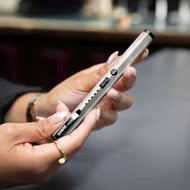
Stun guns operate on a different mechanism than OC-based tools. Rather than a chemical response, they deliver an electrical charge that temporarily disrupts voluntary muscle function, causing pain and incapacitation. Effectiveness is generally immediate upon contact.
The primary limitation of stun guns is range: they require direct physical contact to function. This positions them as a close-contact defensive tool, most effective in situations where an attacker is already within arm's reach. For users who want a non-spray or launcher option, stun guns offer a targeted, contained alternative. Microcoulombs and contact duration both influence effectiveness; models designed for personal defense should meet the 0.5 microcoulomb pain level or ideally the 1.0 or greater intolerable pain level as determined by the National Institute of Justice.
Read Stun Gun Strength Explained: Volts, Microcoloumbs, Effectiveness and Real-World Scenarios to learn more about selecting the most effective stun gun.
Less Lethal Devices vs. Firearms
Firearms offer a higher threshold of stopping power and function at greater distances, but the outcomes associated with their use carry legal, psychological and physical consequences that less lethal tools do not. The question of whether a less lethal tool is "effective enough" relative to a firearm is often the wrong framing.
Less lethal tools are most effective in the scenarios where they are most likely to be used: deterring opportunistic threats, disabling an attacker long enough to escape, and creating distance and time to reach safety. Within their intended use cases, well-manufactured less lethal tools perform reliably and with documented effectiveness across law enforcement and civilian applications.
For users who carry firearms, less lethal tools serve as an intermediate option on the defensive continuum — applicable in situations where lethal force is not legally or ethically warranted. The presence of a less lethal option does not diminish firearm preparedness; it expands the range of situations a user can respond to appropriately.
Effectiveness, ultimately, is not an abstract quality. It is the product of the right tool, proper training, and clear-headed deployment under stress. Less lethal tools meet that standard reliably when the right product is selected and the user is prepared to deploy it.