

Where Is Bear Spray Legal? United States and Canada, Explained
What Is Bear Spray?
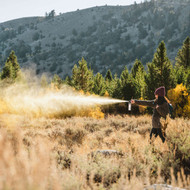
Bear spray is a non-lethal, aerosol animal deterrent specifically formulated to stop aggressive bear behavior during a close encounter. Its active ingredient is oleoresin capsicum (OC) — the same naturally derived compound found in hot peppers — which causes temporary but intense irritation to an animal's eyes, nose, and respiratory system, prompting it to retreat. Learn more, Bear Spray 101: What It Is, How It Works, and Why You Need It.
Unlike personal defense pepper sprays designed for use against humans, bear spray is engineered for wildlife deterrence. It deploys in a wide, dense cloud that reaches up to 25-40 feet, giving users distance and reaction time during a charge. (Note: SABRE Frontiersman MAX offers an industry-leading reach of 40 feet!) Canister size typically ranges from 7.9-10 ounces; the EPA has a minimum canister requirement of 225 grams, or approximately 7.6 ounces. The EPA further requires OC spray concentration to measure between 1% and 2% capsaicin and related capsaicinoids (CRC). At 2.0% CRC, SABRE’s bear spray formula is at the strong end of that concentration and available in 7.9 and 9.2 ounce canisters. What’s more, it offers both EPA and Health Canada approvals and is registered for bears, mountain lions/cougars, pumas, lynxes and all other large cats, in addition to feral or uncontrolled dogs, bison, moose, coyotes, wild boar, possums and racoons. In fact, SABRE’s FRONTIERSMAN Max Bear & Mountain Lion Spray is now registered with the EPA to deter more animals than any other brand.
Another reputable source for bear safety is the Grizzly Bear Committee (IGBC), which supports ongoing conservation of grizzly bear populations and their habitats in areas of the western United States via interagency coordination of policy, planning, management, research and communication. Their recommendations for bear safety build on what is provided by the EPA.
To start, they always recommend consumers use an EPA-registered bear spray that is specifically designed to deter bear attacks. The IGBC also encourages anyone who lives, works or recreates in bear habitat to carry bear spray in an easily accessible manner and to be familiar with how to use it. Carrying bear spray is not a substitute for adhering to proper bear avoidance safety techniques.
More specifically, the IGBC recommends bear spray:
- Be registered with the U.S. Environmental Protection Agency (EPA). The EPA registration number should appear on the product label.
- Be clearly labeled “for deterring attacks by bears.”
- Be used according to the manufacturer’s label instructions.
- Be carried in a readily accessible location (such as a chest or hip holster) whenever recreating or working in bear country.
- Not be used as a campsite or equipment repellent; it is intended only as an airborne deterrent during an aggressive encounter.
The distinctions between bear spray and regular pepper spray for personal defense matter for both safety and legality: bear spray is classified as a pesticide (an animal repellent) under U.S. and Canadian regulatory frameworks, not a personal defense weapon. That classification directly affects where it can be purchased, transported and legally carried.
An earlier study published in the Journal of Wildlife Management found bear spray stopped aggressive bear behavior 92% of the time when used on brown bears, 90% for black bears, and 100% for polar bears. The National Park Service states that bear spray is more effective than firearms in most close-range encounters and poses less risk of injury to the person, the bear, and others nearby.
Where and How Bear Spray Is Used
Bear spray is an essential piece of gear for anyone recreating, working or traveling in areas with active bear populations. Its primary use cases include:
- Backcountry hiking and backpacking in grizzly or black bear habitat
- Hunting, fishing and camping in bear country
- Trail running and mountain biking in high-bear-activity corridors
- Field work, wildlife research and resource management in remote areas
- National park and wilderness area travel where bear encounters are documented
Bear spray is a last-resort tool and should be carried where it can be drawn immediately — in a belt or chest holster — not stored inside a pack. It should not be applied to clothing, tents or gear ahead of time. Bear spray is a repellent in that it can repel during an active approach; it is not a preventative measure.
Legal Considerations: By State, Travel and Country
United States: Federal and State Overview
Bear spray is generally legal in all 50 states for its intended purpose of wildlife deterrence. However, because it is chemically similar to pepper spray, some states regulate it under the same statutes that govern personal defense sprays. The result is a patchwork of rules that vary by canister size, purchase restrictions, and whether the product is classified as a self-defense item or a pest control product.
In most states, bear spray can be purchased without restriction at outdoor retailers and online. The following states carry specific conditions worth noting:
|
Alaska |
Alaska has no statute restricting the purchase or carry of bear spray, and in fact its Department of Fish and Game recommend carrying it if in areas of hiking, camping, hunting and other outdoor activities. |
|
California |
Bear spray is legal in California. Standard commercial canisters (7.9-10 oz) are lawful to possess and carry for wildlife use because bear spray is regulated as a pesticide under California's Food and Agricultural Code, not as a tear gas weapon under Penal Code § 22810. The 2.5-ounce canister limit in § 22810 applies only to self-defense sprays intended for use against humans — not to EPA-registered animal deterrents. |
|
Hawaii |
Standard personal defense pepper spray is legal in Hawaii but restricted to canisters under 0.5 ounces. Bear spray — in its standard commercial size of 7.9-10 ounces — is not permitted under the same framework. Because Hawaii does not have wild bear populations, there is no practical application for bear spray in the state. However, there are approximately 400,000 wild boar or feral pigs roaming Hawaii and SABRE Frontiersman Max is now registered with the EPA to deter wild boar. |
|
Massachusetts |
Bear spray is legal in Massachusetts but regulated under the same statutory framework as personal defense pepper spray. Purchase requires a valid Firearms Identification (FID) Card, and the product must be obtained from a licensed firearms dealer in-state. Online shipping of bear spray to Massachusetts is permitted under the animal repellent classification. |
|
Montana |
Montana has no statute restricting the purchase or carry of bear spray, and like Alaska, Montana’s Fish, Wildlife and Parks Department recommends carrying it in areas of hiking, camping, hunting and other outdoor activities. |
|
New York |
Bear spray is legal in New York. Unlike personal defense pepper spray — which must be purchased in-state from a licensed firearms dealer or pharmacy — bear spray is classified as an animal repellent and is not subject to those purchase restrictions. It can be shipped to New York from online retailers. Keep the original manufacturer label intact to confirm animal repellent classification. |
|
Wyoming |
Wyoming has no statute restricting the purchase or carry of bear spray, and like Alaska and Montana, its Game and Fish Department recommends carrying it in areas of hiking, camping, hunting and other outdoor activities. |
|
Other states |
The remaining states have no statute restricting or recommending the purchase or carry of bear spray. |
National Parks and Federal Lands
Bear spray is permitted and strongly recommended in most U.S. national parks where bears are present, including Yellowstone, Glacier, Grand Teton, Denali, Great Smoky Mountains, Olympic, Rocky Mountain and others. However, individual park regulations govern where and how it can be carried within park boundaries. For example, Denali National Park requires bear spray to be stored inside a pack with a sealed bag before entering buildings or boarding park buses.
There are noteworthy exceptions: Yosemite and Sequoia & Kings Canyon National Parks. Bear spray is specifically prohibited within these parks, with both citing the absence of grizzly bears and the documented behavior of their black bear populations as the basis for the ban. Possession, use or discharge of bear spray is prohibited; visitors should leave bear spray out of their kit entirely when visiting them.
Where allowed, the NPS recommends selecting only EPA-registered bear sprays, like SABRE Frontiersman Max. Personal defense sprays, even if capsaicin-based, are not formulated or registered for use against bears and may not perform reliably in a wildlife encounter.
Air Travel: TSA and FAA Rules
Bear spray is not permitted in carry-on baggage or checked baggage on commercial flights in the United States. The Transportation Security Administration (TSA) and the Federal Aviation Administration (FAA) classify standard bear spray as a hazardous aerosol due to its flammable propellant and the potential for accidental discharge in a pressurized cabin. Commercially available canisters (7.9-10 oz) exceed the 4-ounce threshold that applies to the limited self-defense spray exception in checked baggage.
Travelers flying to their destination should purchase bear spray when they arrive and plan to leave it behind, dispose of it properly at the trailhead, or check with local outfitters about rental programs. Many airports and park visitor centers in bear country have disposal stations. Get more information in SABRE’s helpful guide, Where Can I Buy Bear Spray.
Canada: Federal and Provincial Rules
Bear spray is legal in Canada for wildlife protection use. At the federal level, it is regulated as a pest control product under the Pest Control Products Act and overseen by Health Canada. To be compliant under Canadian law, a bear spray canister must be clearly labeled for use on animals and must not exceed 500 ml (approximately 17 oz) in volume. (SABRE’s bear and mountain lion sprays are certified for use in the country.)
The legal distinction in Canada is critical: pepper spray intended for use against humans is a prohibited weapon under the Criminal Code of Canada. Bear spray, when sold and carried exclusively as an animal repellent, occupies a different legal category. However, carrying bear spray with the intent to use it against a person, or carrying it in an urban setting where that intent might reasonably be inferred, can result in legal charges.
Bear spray is appropriate for wilderness travel in Canada, not for urban carry. Original manufacturer labels must remain on the canister at all times. Removing or obscuring labels that identify the product as an animal repellent can compromise its legal status.
Provincial Considerations
Provincial regulations vary. British Columbia, for example, has active discussions underway regarding tighter restrictions on bear spray sales following documented misuse in urban areas. Vancouver has implemented municipal bylaws requiring retailers to store bear spray out of public reach, verify purchaser age (19+), and maintain sales records. The legal and regulatory landscape in BC is evolving; travelers should verify current rules before purchasing or traveling with bear spray in that province.
Air Travel in Canada
The Canadian Air Transport Security Authority (CATSA) also prohibits bear spray in both carry-on and checked baggage on commercial flights. Air Canada and other Canadian carriers follow this restriction. As with travel in the U.S., the recommended approach is to purchase bear spray upon arrival at your destination.
A Note on Product Verification
Always purchase from reputable, established brands. SABRE is ISO 9001:2015 certified and produces bear spray registered with both the EPA and Health Canada. The company subjects its products to rigorous batch testing to verify formula strength — a critical differentiator in a category where quality directly affects safety outcomes.
A lower price point does not indicate equivalent performance, and always research beyond the marketing hype. Verify EPA or Health Canada registration on the label, check the expiration date, inspect the safety mechanism, and review the manufacturer's deployment instructions before heading into bear country.
Disclaimer: Laws governing the purchase, possession, and carry of bear spray vary by jurisdiction and are subject to change. This post reflects publicly available information as of early 2025. Always verify current state, provincial and local regulations before purchasing or transporting bear spray. This content does not constitute legal advice.