Mountain Lion or Cougar Defense: Will Bear Spray Work?
Mountain lions are elusive predators that inhabit vast stretches of North America, from the Rocky Mountains to the Pacific Coast. For hikers, hunters, trail runners and backcountry campers, the question isn't whether cougars are present – it’s what to do if you encounter one.
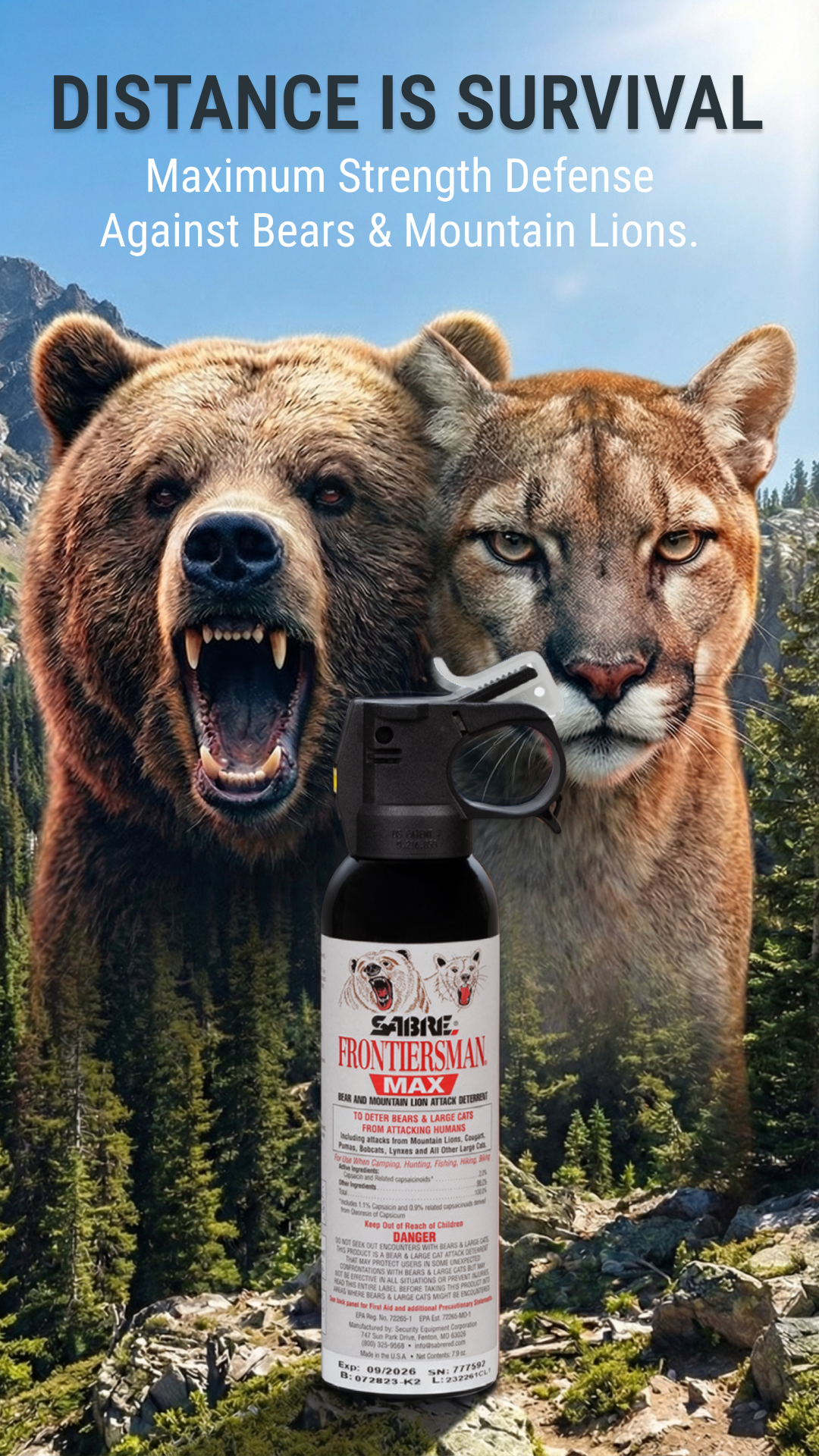
Bear spray is the gold standard for wildlife defense in bear country. There are Environmental Protection Agency (EPA)-registered sprays specifically approved for both bears and mountain lions. Backed by robust field and quality testing, products like SABRE’s Frontiersman Max are effective deterrents against both bears and cougars.
Are cougars and mountain lions the same thing?
Yes. According to the World Wildlife Federation, “The mountain lion—also known as the cougar, puma, panther or catamount—is a sleek, powerful feline native to diverse habitats across the Americas.”
What is bear spray?
Bear spray is an aerosol deterrent designed to stop aggressive wildlife. The active ingredient is oleoresin capsicum (OC), the compound that makes pepper spicy. When deployed, the spray creates an inflammatory response that affects the animal's snout, eyes, and respiratory system, temporarily incapacitating them to stop its approach without causing permanent harm.
Unlike regular pepper spray, which is carried for use against a would-be human attacker, bear spray offers a longer range and greater strength. Bear and mountain lion spray and pepper spray are for use against different targets and cannot be used interchangeably.
Understanding cougar behavior
Mountain lions are ambush predators that may engage in bluff charges or defense displays, rely on stealth and surprise. They typically stalk prey from cover, approaching undetected before a rapid attack. Adult cougars can reach speeds of 35 to 40 miles per hour in short bursts.
Attacks occur when humans surprise a cougar at close range, encounter a female with kittens, or inadvertently trigger predatory behavior through certain actions, like running away. Warning signs of cougar presence include fresh tracks, scat, scratch marks on trees (often several feet off the ground), and scraps where the animal has cached prey under dirt and debris. You are most likely to encounter mountain lions at dawn and dusk when they are actively hunting.
The ambush nature of cougars creates a unique challenge for defense. While bear encounters often involve visual and auditory warning signs before an attack, cougar encounters may provide little to no advance notice.
Is bear spray effective against cougars?
Previous wildlife deterrent spray focused primarily on bears, where years of field data demonstrate high success rates. A study published in the Journal of Wild Life Management analyzed 83 incidents in Alaska and found bear spray stopped aggressive behavior in 92% of cases, with no human injuries or fatalities in 98% of incidents.
Research specific to mountain lions is more limited, in large part because cougar attacks are far less common. While data remains limited compared to bear spray statistics, wildlife management agencies, including the California Department of Fish and Wildlife and Colorado Parks and Wildlife say capsaicinoid spray is a legitimate deterrent option against cougars.
Look for bear spray products that have undergone rigorous testing and meet regulatory standards. SABRE’s Frontiersman Max, for example, is tested in its industry-exclusive, in-house HPLC lab, in addition to proven field testing by Elmendorf Air Force Base and Brown Bear Resources. Frontiersman Max is also approved by the EPA and Health Canada.
Why is it called “bear spray” if it works on multiple animals?
There is no specific reason for this – product naming is entirely up to different manufacturers. SABRE’s Frontiersmen Max is specifically called “Bear and Mountain Lion Spray.”
Why does capsaicinoid spray work on multiple species?
There are three prevailing types of pepper spray and pepper gel; those for use against humans, dogs and large animals, like bears and cougars. They have different handling and strength depending on the situation.
However, each has capsaicin as the major component and the inflammatory response is the same across all mammals, regardless of size. The 2% major capsaicinoid concentration in bear and mountain lion spray represents the maximum strength allowed under federal law and is exclusive for use against larger mammals like cougars. The higher concentration helps ensure effectiveness at the distances and under the conditions typical of wildlife encounters.
What else should someone know before using cougar spray?
Distance is critical in any wildlife encounter. The farther you can deploy an effective deterrent, the more time you have to react and the greater your safety margin.
Standard bear spray formulations deliver effective coverage at 20 to 25 feet, but some, like Frontiersman Max from SABRE provide nearly double that with a range of up to 40 feet. The extended range is especially valuable in cougar encounters. Consider this: mountain lions can accelerate from 0 to 35 miles per hour in seconds. At that speed, they cover about 50 feet per second. The difference between a 20-foot and 40-foot effective range translates to nearly a full second of additional reaction time.
The fog pattern used in wildlife sprays has a wide coverage, which compensates for the reduced accuracy that often comes with adrenaline and rapid movement during a potential attack. The user doesn’t need to have a precise aim to create a barrier between themselves and a threat.
Wind conditions are another factor that affects the spray. Deploying into a headwind reduces effective range and can blow back onto the user. Crosswinds can shift the fog pattern. In these less favorable conditions, adjust your position to be upwind.
Are there limitations with cougar spray?
No wildlife deterrent is 100% foolproof because deployment accuracy, deployment conditions and animal aggression levels all play a factor in its success. However, bear and mountain lion spray remain the most recommended deterrent for those engaging in outdoor activities in bear country.
Unlike bear encounters, which typically involve visual contact and escalating behavior before an attack, cougar encounters may provide minimal warning. A mountain lion stalking from cover can close the distance before a target is aware of its presence. This makes canister access particularly critical. Spray stored in a backpack cannot be deployed quickly enough to stop a charging animal. Deterrent spray should be immediately accessible on a belt or chest holster. Practice removing the spray before you begin your outdoor adventure to ensure you can deploy it within a few seconds.
What else can I do to protect against a cougar attack?
As shared at the outset, cougar attacks against humans are incredibly rare. Carrying bear and mountain lion spray is the best deterrent in the unlikely event that one does occur. However, there are other considerations that can prevent an animal from approaching in the first place.
-
Make noise:
Making noise while you’re moving through bear country often discourages an animal from approaching – and frequently ensures they stay far away. In dense cover or near water where sound is masked, periodic calls or clapping help prevent surprise meetings at close range. You can also consider something like an air horn.
-
Stay in groups:
According to Colorado Parks and Wildlife, the majority of mountain lion attacks involve solo hikers or individuals separated from groups. Cougars are less likely to approach multiple people, and groups provide more eyes to spot wildlife before close encounters occur.
-
Consider the time of day:
Cougars are most active during dawn and dusk. Hiking during midday reduces the likelihood of encounters. If dawn or dusk hiking is necessary, increase awareness and keep deterrent spray nearby. -
Watch children and pets:
Small individuals running or making erratic movements can trigger predatory behavior. Keep children close and in sight. Never allow children to hike ahead or lag behind the group. Pets should be leashed at all times.
-
Don't give animals a reason to approach:
Pack up all trash and food scraps, and store food in secure containers designed to prevent wildlife access and keep animals from associating people with food sources.
-
Stop moving if you spot a cougar:
Running triggers pursuit instincts in predatory cats. Instead, face the animal, make yourself appear larger by raising your arms or opening your jacket, and back away slowly while maintaining eye contact. Speak loudly and firmly. Create distance, but do not turn your back until the animal has left the area completely.
Can I use a gun in a cougar attack?
Bear and mountain lion spray is always the recommended choice in the event of an
encounter, for the safety of both the individual and the animal.
A firearm requires precise aim, whereas a spray does not require perfect accuracy. In Bear Spray vs. Gunn: Safety, Accuracy and Effectiveness Explained, SABRE cites one article quote: “Law enforcement agents for the U.S. Fish and Wildlife Service have experience that supports this reality – based on their investigations of human-bear encounters since 1992, persons encountering grizzlies and defending themselves with firearms suffer injury about 50% of the time. During the same period, persons defending themselves with pepper spray escaped injury most of the time, and those who were injured experienced shorter duration attacks and less severe injuries.” Read the full post to learn more about the risks of using a firearm compared to the effectiveness of bear and mountain lion spray.
How do I respond to a cougar encounter?
Direct cougar encounters demand immediate, deliberate responses. Your actions in the first seconds determine the outcome.
- Do not run. This cannot be overstated. Running triggers a mountain lion's chase instinct. At 35 miles per hour, a cougar will overtake any human within seconds. Running also positions you as prey and removes any possibility of deterrence or defense.
- Make yourself appear larger. Raise your arms overhead and open your jacket or shirt. If you're carrying a backpack, hold it above your head. Cougars assess threats by size, and appearing larger can shift the animal's perception from "prey" to "potential threat."
- Maintain eye contact. Predatory cats often attack when their target looks away. Keep eye contact to signal awareness and confidence.
- Speak firmly and loudly. Use a strong, authoritative voice. Shout phrases like "Go away" or "Get back." The goal is to present yourself as a threat rather than prey. High-pitched screaming can sound like prey in distress; use a deep, commanding tone instead.
- Back away slowly. Create distance without turning your back or breaking eye contact. Move at a steady pace – don’t rush or freeze. Watch for obstacles behind you, but keep your primary focus on the animal. The goal is to exit the animal's territory without triggering an attack.
- Deploy deterrent spray at the appropriate range. If the cougar approaches despite your defensive posture, prepare the spray. Aim for the face and head, releasing the spray in controlled bursts. Continue backing away as you spray.
Can I travel with mountain lion spray?
Bear and cougar spray are not permitted on planes, in either checked or carry-on luggage. Plan to purchase the spray once you’re at your location. Learn more in this article, You Asked We Answered: Where Can I Buy Bear Spray.
Wildlife deterrent spray works on mountain lions the same way it’s effective against bears. EPA-registered formulations approved for both species represent tested, verified tools backed by regulatory oversight and field data.
However, deterrent spray is not a substitute for awareness and prevention. Mountain lions are ambush predators that may provide minimal warning before an attack. The most effective defense combines proper carrying position, practiced deployment, situational awareness and appropriate behavior when cougars are spotted.
Proper preparation and quality equipment provide peace of mind in the wilderness. They don't eliminate risk, but they shift the odds substantially, allowing you to enjoy and share the habitat with one of North America's most efficient predators.