

Evaluating Pepper Spray Strength: The Myth of SHUs
Pepper spray is one of the most commonly used personal safety devices. Its effectiveness is not just one number, but several related metrics: OC concentration, delivery method, total spray time, legal limits, and quality testing. (Read more: The Defense Spray Showdown)
There are many common misconceptions, especially around the marketing of pepper spray strength.
What is the main ingredient in pepper spray?
The primary ingredient in pepper spray is Oleoresin Capsicum (OC), which is derived from chilli peppers, and causes inflammation and irritation of the eyes, skin, and respiratory systems, often disabling an attacker long enough for escape.
How is pepper spray strength measured?
There are three ways companies might market pepper spray strength: OC percentage, Major Capsaicinoids (MCs) and Scoville Heat Units (SHUs). The most reliable of these is Major Capsaicinoids.
Let’s still break down each measurement.
OC percentage
Pepper sprays contain anywhere from 2-10 percent OC, but OC% only measures the amount of raw pepper or Oleoresin Capsicum (OC) within the pepper spray formulation. It does not take into account the actual potency of that OC.
SHUs
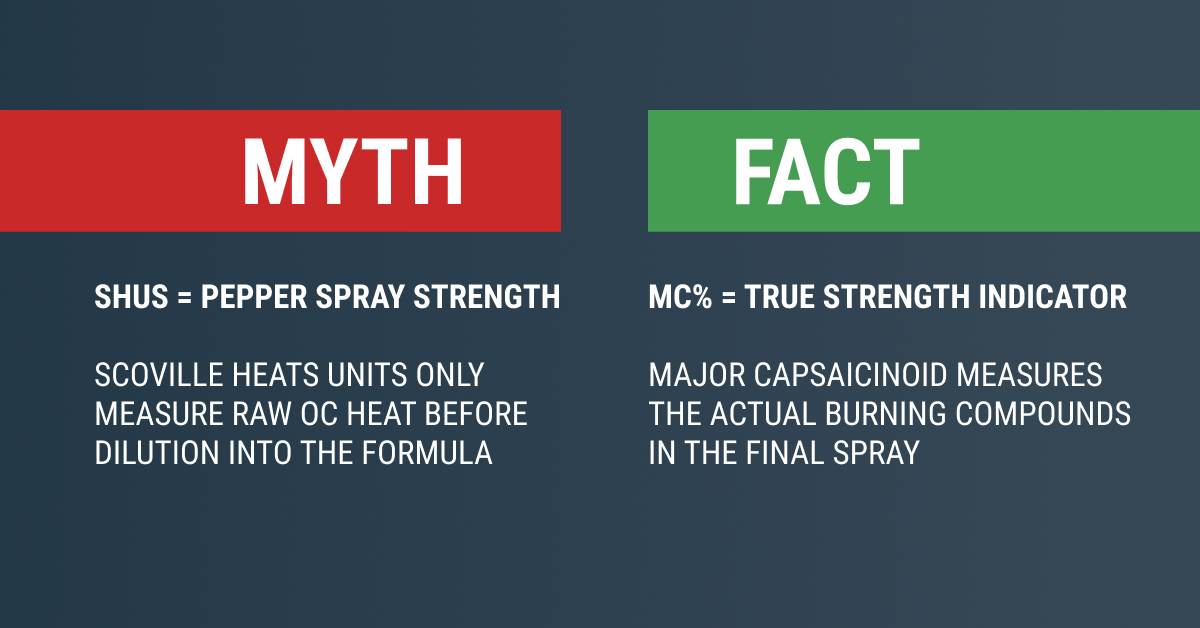
Many pepper spray brands use different marketing terms—like high Scoville Heat Units (SHU) or large OC percentages—to promote “strength,” which can be confusing for consumers. The problem is that Scoville Heat Units (SHUs) alone are not an accurate way to measure pepper spray strength. SHU only measures the heat of the raw oleoresin capsicum (OC) before it’s added to the formula. Once OC is diluted into a finished pepper spray, often reduced by 90–98%, SHU numbers no longer reflect how powerful the spray actually is.
The most accurate way to compare pepper spray strength is by looking at MC% (major capsaicinoid percentage), which measures the concentration of the compounds responsible for the intense burning and incapacitating effects. For example, a pepper spray marketed as 5.3 million SHU with 2% OC measures only 0.71% MC, while a spray with 2 million SHU and 10% OC measures 1.33% MC. Even though 5.3 million SHU sounds far stronger on paper, the second spray delivers significantly more real-world strength. That’s why MC%—not SHU or OC percentage—is the most reliable indicator of pepper spray effectiveness.
Major Capsaicinoids
This is the most reliable indicator of pepper spray potency, as recognized by the Environmental Protection Agency in the United States. It represents the strength of the entire formulation within the pepper spray.
Typical sprays range from 0.18 to 1.33% MC. The higher the MC of the pepper spray the greater the potency. For instance, bear spray measures between 1% and 2% MCs. At this strength, it is not legal to carry for personal use against a potential human attacker.
The marketing myth of SHUs
Some pepper spray manufacturers use SHUs to determine how much heat is in their pepper spray because the number sounds impressive – in the millions! The lack of universal testing standards and labeling practices can make it difficult to compare brands and pepper spray strength.
Tip: Always look for the Major Capsaicinoids (MC%) percentage or ask for the number specifically before making a purchase.
Additional factors that affect pepper spray strength
The strength of a product’s ingredients is only one indicator of its overall effectiveness. Several additional factors can significantly influence how well pepper spray works in real-world situations, including the following:
Spray pattern
Pepper sprays and pepper gels differ in how they are dispersed. While both contain the same active ingredient, pepper gel is released in a thicker, gel-like stream that sticks to the attacker. This can provide greater precision, reduce blowback, and lower the risk of accidental exposure. (Read more: A Complete Guide on Pepper Spray and Pepper Gel Explained)
Range
Personal-use pepper sprays typically have an effective range of about 12–14 feet. Home-defense pepper gels often reach more than twice that distance, while bear spray can project up to four times farther than standard personal-defense pepper spray devices.
Volume and duration
The amount of product in a canister affects how long it can be deployed. Whether a spray releases in short bursts or a continuous stream also influences effectiveness and is especially impacted by environmental conditions. According to the National Institute of Justice, approximately 40% of the time, home invasions occur with more than one intruder. Look for a product with at least a 10-second spray time, giving you more time to react and protect yourself against multiple attackers if need be.
Target area and exposure time
For maximum effect, it is important to spray ear to ear and across the eyes. While brief exposure can still be effective, longer exposure generally allows more contact with the eyes which is the primary target.
Human response
Individual responses to pepper spray can vary widely. Differences in pain tolerance, physiology, and situational factors, such as adrenaline or the presence of drugs or alcohol, can make a person more or less susceptible to its effects. However, pepper spray does cause involuntary eye closure upon contact. So even if someone is under the influence of drugs or alcohol, pepper spray will cause eye closure if contact is made with the eyes, giving you an opportunity to escape.
In the end, pepper spray “strength” cannot be reduced to a single headline number or marketing claim. Understanding how potency is measured – especially through Major Capsaicinoids – along with delivery method, total spray time, and real-world conditions leads to more informed and responsible choices. Consumers should be cautious of exaggerated SHU claims and focus instead on verified, meaningful metrics and products that undergo heavy quality assurance testing, like those evaluated in SABRE’s industry-exclusive HPLC lab. When considered properly, pepper spray is best understood as a system of factors working together, not just a measure of heat.