

Stun Gun Strength Explained: Volts, Microcoloumbs, Effectiveness and Real-World Scenarios
Stun guns, called CEDs or conducted energy devices by some organizations, are personal safety devices that use a high-voltage, low-power charge of electricity to induce involuntary muscle contractions that can cause temporary incapacitation. They work through direct contact with an assailant to help give you time to move to safety.
Shoppers looking for the best effective personal safety device often ask about a stun gun's strength. Stun gun “strength” is determined by a number of factors, including volts, amps, effect and real-world performance.
What does “strength” mean in relation to a stun gun?
Most often, consumers likely think of “volts” when considering the power of a stun gun. However, the true effectiveness of one is a combination of things:
- Electrical charge (volts)
- Microcoloumbs
- Current (amps)
- Contact time
- Placement on the body
- User training and comfort
As noted by the National Institute of Justice, part of the U.S. Department of Justice, “the effectiveness and safety of stun guns are a function of the quality of the training.” While this article is specific to law enforcement, it provides a critical reminder to all users. Practice gripping and activating the device ahead of real-world use contributes to comfort and confidence with the device, ensuring it is available and accessible when you need it most.
Stun guns can be a powerful tool for personal safety. In addition to considering personal preference, always check your state and local laws before purchasing or using one.
Is voltage the ultimate measure of stun gun power?
Many brands promote the voltage of a stun gun – some claiming 5 million, 20 million and even 100 million volts. Numbers that are splashed across packaging and advertising create confusion. Looking at the marketing alone, it would stand to reason that high voltage equals a stronger stun gun.
However, voltage is mostly a marketing number instead of a real measure of stopping power.
In the simplest terms, “voltage” is the spark that gets electricity into the body. A higher voltage helps the electricity to make better contact on the skin or to be effective against thick clothing.
- Higher voltage = easier for a stun gun to arc through clothing
- Lower voltage = more pressure might be needed to make effective contact
One article in Scientific Research Papers identified test specifications for stun guns and related devices, emphasizing measurement that includes both voltage and current under load, rather than voltage alone.
The myth of the “million volt” stun gun
As noted on the SABRE site, “If you've ever shopped around for stun guns, you've seen plenty of extremely high voltage claims – possibly up to 100 million volts. These astronomical figures sound impressive, but the truth is, when it comes to stun guns, claims like these are not only wildly misleading, but also physically impossible.”
Independent lab testing reinforced SABRE’s statement. One study [opens as a PDF] of 244 tests on 41 different models of stun guns from different manufacturers showed “high variability is electrical output and stability. Manufacturer’s performance claims on product packing [were] unrealistic and unproven.”
Years ago, many brands began advertising “million-volt” devices because they looked impressive. In reality, those numbers refer to open-circuit voltage, which is what the stun gun produces in the area – not what it actually delivers when it makes contact with an attacker. Once a stun gun is pressed against a real target, the voltage drops dramatically.
“A stun gun with excessively high voltage but a weak current creates noise and a bright arc, but not necessarily a strong ultimate effect,” said David Nance, CEO, SABRE. “From the start, SABRE has been committed to educating customers on stun gun purchases and use, and ensuring we provide only reliable and proven information to help them make the most informed decisions.”
How many volts should a stun gun have?
Many civilian stun guns advertise volts in the millions, but “30 million volts” is not necessarily better than five million. Instead, when buying a stun gun, look for a reputable brand like SABRE, strong battery life, good design, and reliable, industry-leading testing.
Avoid cheap devices with exaggerated claims.
“SABRE does not measure its stun guns in volts,” continued Nance. “We look at Microcoulombs, which measure charge (current x time).”
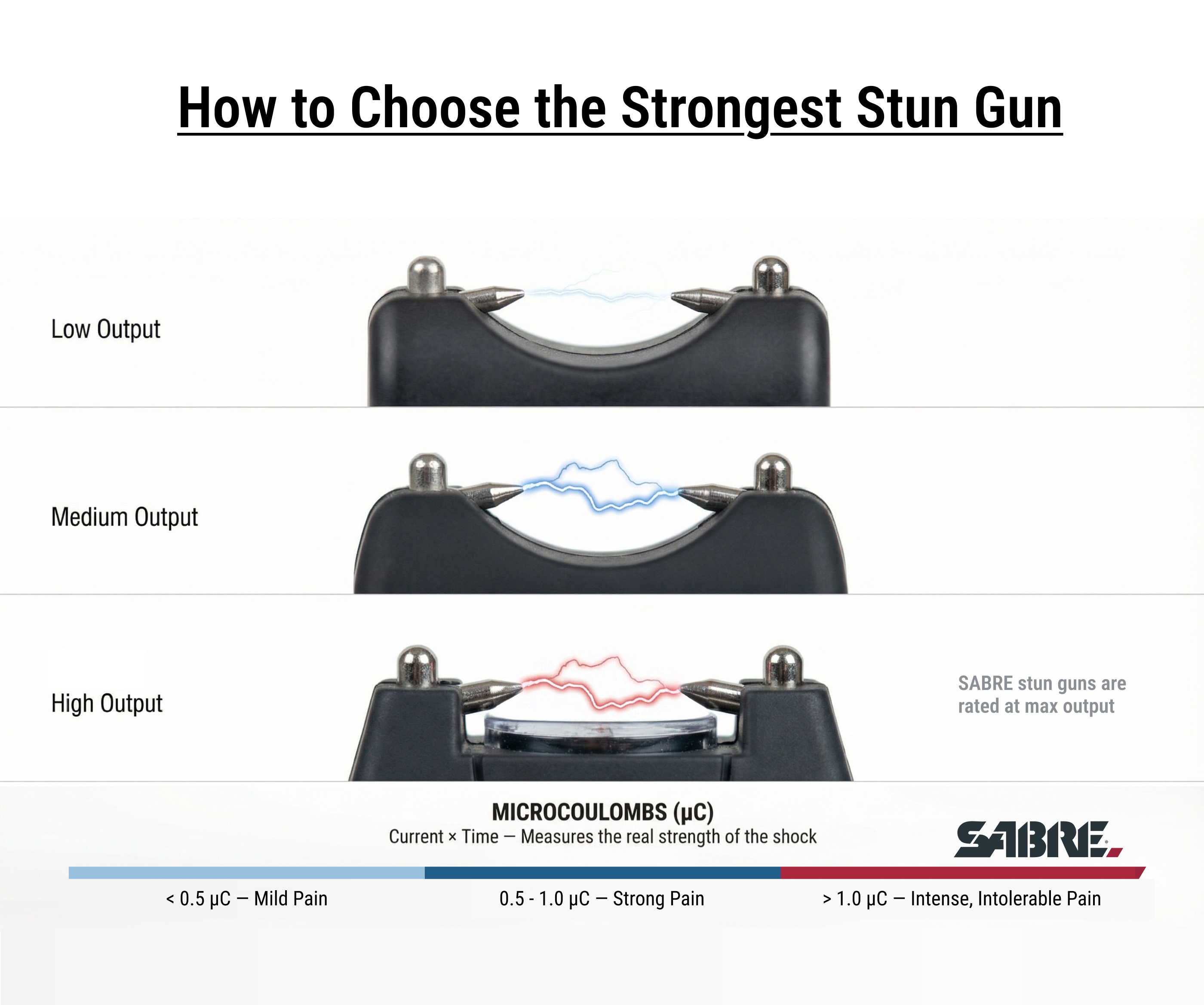
SABRE’s breakdown of Stun Gun Voltage vs. Microcoulombs uses the popular analogy, comparing stun guns to water in the home.
- Current = flow of electricity (measured in amps) = “water in the pipe”
- Voltage = force of an electrical current (measured in volts) = “water pressure”
- Charge = amount of electricity (measured in coulombs or microcoulombs) - “quality of the water”
Illustrated this way, voltage allows the charge to pass through but it does not cause pain on its own. It must be coupled with a significant charge. SABRE testing thresholds consider anything 0.5 microcoulombs (µC) is likely to cause pain, while 1 µC or greater is likely to cause intolerable pain, according to the National Institute of Justice.
SABRE’s 2-in-1 stun gun and flashlight clocks in at 1.6 µC, while its 2-in-1 tactical series stun gun LED flashlight delivers 2.517 µC.
How long do the effects of a stun gun last?
The effects of a stun gun vary based on where on the body it makes contact, how long it’s held against the attacker, and the thickness of clothing or the size of the target. Despite what is shown in the movies, a stun gun does not necessarily drop a target instantly. A user must continue to press the device for contact to ensure effectiveness. When used successfully, stun gun effects can last several minutes, giving you time to escape to safety.